Sunday, March 23, 2014

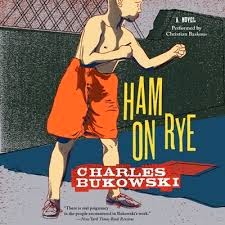
Ham on Rye, the end!

I have completed my novel Ham on Rye!!  I enjoy reading but because of my class, work and family schedule I rarely have the time so in a sense I am glad to have taken this class.  There were some disturbing points that would make you shake your head, but overall the book was a pretty good read.
I was a bit confused as to why there weren’t very many references to food but by the end of the novel I was well aware that this family is living through the great depression, poor and most of the children were ill-fed. I felt bad for Henry (the main character) when he was in high school he had terrible acne that blistered and oozed puss when they burst. GROSS, I know.  His acne had gotten so bad he had to leave school for a while to seek treatment. He had an 8:30 appointment with 40-50 people waiting, no guarantee to see a doctor and if you leave you lose your spot.  Here in Kalamazoo we have a dental clinic geared to the unemployed and low income families.  You have to be there by 7:30am and there is always a line that starts way before 7:30.  It’s a first come first serve basis and if you leave you lose your spot and have to come back the next day as well.  This part was interesting for me to read because the author is referring to his life back in the 1930’s and the poor is still being treated the same way today.
There was one statement that really stood out for me and it said “I guess the only time people think about injustice is when it happens to them”.  This is so true.  I know some wealthy people who ride pass Loaves and Fishes or the Salvation Army and haven’t even thought about giving to the poor or less fortunate.   Here I am, head just barely above water giving to these organizations.  I do it because I care and one day it could be me in need. We talked in class how restaurant workers are striking and asking for a pay increase of up to $15 per hour.  I was quick to say “they don’t deserve that much, flipping burgers requires no education and no skills”. But I wasn’t saying that when I made $9 buck trying to take care of a kid and pay rent.  So in other words, whether it’s our situation or not we should try to make a difference in the lives of others.

Wednesday, March 19, 2014

Ham on Rye pages 50-100

I will start by saying I’m a tad late posting my blog this week but a little late is always better than never.  I was a bit confused as to why there weren’t any references to food in these 50 pages compared the first 50 pages.  Matt who is also reading Ham on Rye brought up a really good point that this section of the book is probably taking place during the great depression which led to vast food shortages, and I think he is spot on with that assumption. 

I believe the author’s way of conveying his message is very direct, explicit and at times too detailed. The events he wishes to expose that has taken place throughout his life is almost disturbing at times. The fact that a child could be beaten for not cutting the grass correctly is horrible.  His father would get down on his hands and knees to look for hairs (grass) left behind.  Then when he found them he would beat the kid and his mother was ok by it.  I have a son old enough to cut grass and I would never hit him because he didn’t cut the grass my way.  And secondly I am not getting down on my hands and knees to check for anything!!   He also beat his wife which is insane.  He had an affair and when the woman showed up at their house she stole his car.  He then went back inside and beat his wife with his child in the other room. Very disturbing.  Another part of the book that’s a bit too detailed for me is the fact he keeps referring to women’s private parts and what he wants to do J.  I guess it bothers me because him and his friend are only in the fourth and fifth grade and they should be focusing on grammar and math equations.  How and why would they be thinking of such things?  I guess some good did come out of reading this portion of the book because it prompted a sex talk between me and my son who is in the eighth grade.

Saturday, March 15, 2014

Ham on Rye

As I have read the first 50 pages of Ham on Rye my first impression is the author is hilarious. He has a funny way of conveying his message and does a lot of cursing.  I have not totally made the connection that is related to our class as far as food literature but I’m sure there is some point to reading this novel.
http://en.wikipedia.org/wiki/Charles_BukowskiCharles Bukowski is the author of Ham on Rye and this book is a reflection of his life growing up as a child through his adolescent years.  He did not like his father stating he was always mad about something and always started conflicts.  For instance, they would go out to eat which was very seldom and his father would find something wrong with the food so they wouldn’t have to pay.  He once said to the waiter “there’s flyshit in this whipped cream! What the hell kind of place is this”.  They asked him to leave and he responded by stating he would leave but would be back to burn the “god-damn” place down.  I have known people to do this and it’s not that they couldn’t afford to pay for the food; they just didn’t want to pay.  Another interesting part for me is when they went into an orchard and decided to pick oranges that did not belong to them.  They normally had a picnic basket full of food but on this particular Sunday the basket was empty.  As the family was picking oranges the owner of the orchard arose and asked them to dump all the oranges and to leave his property.  The father stated “there are plenty of god-damned oranges and you won’t miss a few oranges”.  The owner pointed his shotgun at the father and told him get off his property.  The father responded “Guys like you ought to be hung”.  At this point I can see the father’s frustration that this man has all these oranges (food) and people are hungry and starving.  I can remember when I went to Florida and seen an orchard for the first time it was rows and rows of oranges.  I did ask if we could pick a few and of course she said no, but they did offer samples of orange juice and you were welcome to buy as much as you wanted. As I think back on the situation, I understand people have to make a living but why not help the people within your community who are in need and hungry like this family? It could be the first step in fighting hunger in a community....

Sunday, March 9, 2014

The Hunger Games

What an awesome book!  I totally agree with Stephen King when he states The Hunger Games is violent but jarring novel that generates constant suspense. I couldn’t stop reading it as I found myself laughing and even disappointed when Rue was killed during the games.  I have always turned the channel when I knew The Hunger Games was on television, but now I can’t wait to watch the movie after reading such a great book.
 I know the book is fictional based but there are some similarities throughout I could relate to the world in which we live.  Some people in society are better off than others. A person’s financial or social status can easily dictate whether a person will become homeless or go hungry similar to the tributes fighting in the games.  The tributes from district 12 are poor and dying from starvation where as the people from the Capitol seems to have all the wealth and plenty of food. The districts uneven distribution of food is no different from our uneven distribution of wealth. People in the U.S are deciding whether to pay bills or buy groceries and there are plenty of wealthy corporations that could fight or eliminate hunger but their main focus is their current interest and profits.
Another point that stuck out for me throughout the book is how some districts are better off than other districts and our communities are just the same. For instance some communities in Kalamazoo are considered to be poor and are usually the last to be economically development. When on the other hand, if you drive a bit further west there are several grocery stores and new developments being constructed as I write. So although the book is based on fiction there are some topics throughout that have some correlation to our society and our battles with hunger.


Tuesday, February 25, 2014

My Confession

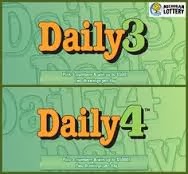
I have chosen to make a confession in my blog this week.  I am a gambler and I enjoy winning all the time, but it sucks to lose.  I am on a roll this year, so much that I have to brag a little. My girlfriend tells me I have the Michigan lottery down to a science and I’m almost starting to believe her.   I have won 10 times so far this year and hope to keep this winning streak going ALL year long.  I prefer to play the Michigan’s lottery daily 3 and daily 4 digit numbers because I have better odds at winning.  You can play these games twice a day, every day but I choose to only play once a day.  You can win as much as $500 on the daily 3 digit and up to $5000 on the daily 4 and cost one dollar per ticket. I have won both amounts multiple times in the last year and my dad say some people are just lucky and I am one. He has been playing for over 10 years and has never won over $500.  I play 2 sets of numbers every day for instance one of my numbers is 329 which is my sisters birthday. I don’t believe in all the superstitions that come with playing the lottery.  For instance some people believe that if you tell others your lottery numbers its bad luck or if someone dies there are certain numbers you should play that stand for death. There are also dream numbers meaning if you have a dream about a dog there are numbers that play for dog, such as 820. I know weird right? But some people are very serious when it comes to the playing the lottery. People can also get carried away playing their lottery numbers as well.  I have stood behind people playing number who have spent as much as $100.  I don’t know how that possible but it’s not my busy nor my problem.  I spend $15 a week and some of you might even think that’s a lot. But my philosophy is that when you work hard you can take a percentage of your paycheck and play hard if that’s what floats your boat!!

Sunday, February 23, 2014

The Jungle (Chapters 6-13)

The section I read in The Jungle was chapters 6-13.  It is not as gruesome as the first part of the book, but I found a lot of interesting sections throughout these chapters.  As I continue to read it’s hard for me to understand how immigrants can come to a country not knowing anything in hopes of a better life.  These individuals are taken advantage of in the worst ways and still have hope of living the “American dream”.  As this family moves through one difficulty it seems as if another is soon to appear.

One part I found troubling to read is how Jurgis and others on the killing-bed were robbed of their wages in chapter 8.  If a man is one minute late he would be docked a full hour but still made to work the balance of that hour, so e.g. he was made to work for free. If a man came to work early you would not get paid even though the packers would have them start work 15 minutes early.  And if a man worked for 50 minutes he would not be paid because it didn’t put in a full hour of work.  How could anyone really know what they were going to earn for the week or what they could afford being cheated in this way? No wonder this family was so worried about starving or how they could afford to pay for their home.  I find it appalling to know that people can be treated this way because they don’t understand their rights or not represented by a union.

Another disturbing part of the book for me is the conditions these immigrants worked under and the toll it has on their bodies.  One section describes how their nails had worn off from pulling hides or all the joints in their fingers would be eaten by the acid in the pickle-rooms.  The people who worked in the chilling-room had a disease called rheumatism and in the cooking-rooms the germs of tuberculosis might live for two years despite inspections.  I couldn’t even image working in such conditions, but as we discussed in class last week some people don’t have a choice or what they are doing is much better than where they came from.


Tuesday, February 18, 2014

The Jungle

It’s remarkable how families come to America not knowing anyone, our culture or even the language.  This novel is relevant in many ways to our discussions in class of about the meat packing industry and the lives of immigrant workers. These families are seeking riches, security and freedom that may not be obtainable in their native country. Jurgis is no different than any other immigrant worker coming to this county trying to make a living only to be subjected to low wages and indescribable accumulations of filth.

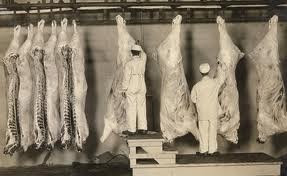
As I continue to read The Jungle, by Upton Sinclair I can’t help but to notice how graphically detailed the explanation is of Jurgis’s new job. I’m not sure if I could work in such horrific conditions that have been described.  The atmosphere is really put into perspective when they describe that every hour four to five hundred cattle are turned into meat.  Not to mention the cows are treated terribly by being shocked and poisoned, their throats being slit, and being hung by their feet.  One fascinating part of the book thus far is the fact they use every part of the animal.  The bones are used for fertilizer, the bristle can be cleaned and dried to make hair cushions and the feet can be made into glue. Another part I to be interesting is how some meat is marker with a “kosher” sign, which indicates the meat has been killed by special methods and processes.  This meat is intended to be eaten by Orthodox Jew in conformance with Leviticus 17.10-14, based on the dietary laws of the Hebrew Bible.